
By November, the beach bars along Naxos's west coast have stacked their sunbeds and gone quiet. But Naxos is a working island, with farms, villages and a main town that carry on through the winter. Late autumn is when the inland valleys turn green again, the light softens, and you can walk ancient paths without the August heat. Here are seven ways to spend it.
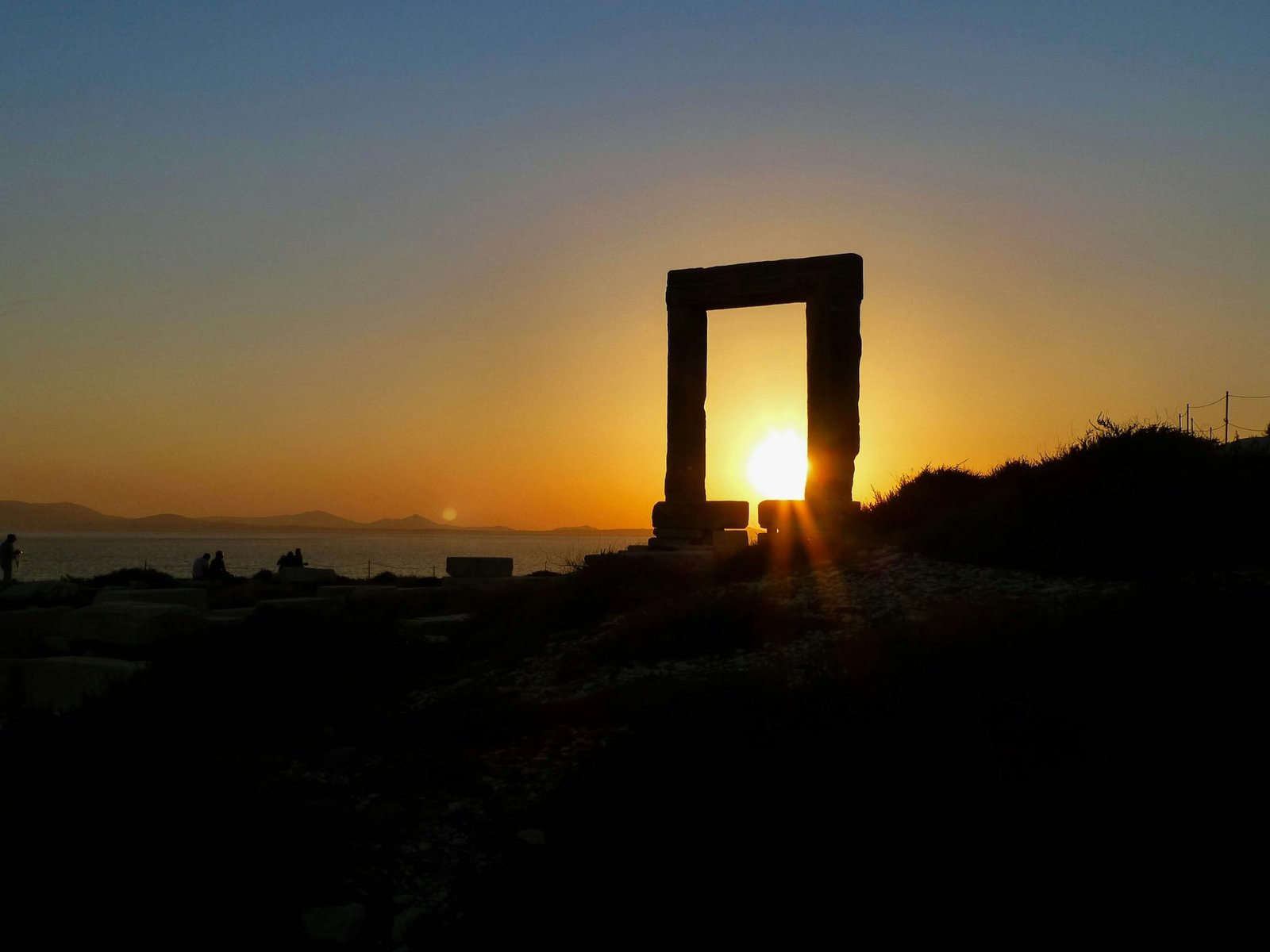
Watch the sun set through the Portara
The great marble doorway on the islet of Palatia is the first thing you see when your ferry pulls into Chora, and it is even better on foot. It is all that stands of a temple to Apollo begun around 530 BC under the tyrant Lygdamis and never finished. The four marble pieces of the frame weigh roughly 20 tonnes each. A paved path links the islet to the harbour, and on a clear autumn evening the sunset here is the island's quiet ritual.
Get lost in the lanes of the Kastro
Above the harbour, Chora climbs to the Venetian Kastro, a maze of narrow alleys, arches and old mansions, some still bearing family coats of arms over the doorways. Out of season you will share the lanes with residents rather than tour groups, which suits the place. Chora is the part of Naxos with the most year-round life, so it makes a sensible base for a late-autumn stay, with shops and tavernas that serve locals as well as visitors.
Walk the Byzantine trail of the Tragea valley
The Tragea, in the island's green centre, has some 30 Byzantine churches, many with rare frescoes. The municipality's Trail 4 is a circular route from Chalki through Monitsia, Moni, Kaloxylos and Akadimi, past olive groves, oak woods, a watermill and chapels with frescoes, including Panagia Drossiani, whose wall paintings span the 7th to 14th centuries. Cool, dry days are ideal for this. Seeing inside many of the churches may need the help of a caretaker in the nearest village, the keeper of the keys, so ask politely in the café or kafeneio.
Visit the Temple of Demeter at Sangri
Inland near Sangri stands a rare Ionic temple to Demeter, built entirely of marble around 530 BC and later turned into a Christian basilica. Its square plan is unusual, and much of the original marble survives. The ticket also covers the small Sangri collection of finds next to it. The site is open 08:30–15:30 and closed on Tuesdays, with last admission 20 minutes before closing. A full ticket costs €5 (€3 reduced). From 1 November to 31 March, entry is free on the first and third Sunday of each month. Check before you travel.
Find the sleeping kouroi of Melanes
In the Flerio area, near the village of Melanes, an enormous unfinished marble youth lies where it was abandoned in the early 6th century BC. Accidents while the statues were being moved down from the quarry broke their limbs, and they were left where they lay. A second kouros lies nearby at Faraggi. The municipality's tourism site lists the area as free to enter and open at all hours, with signposted footpaths from the stream and a car park. In November the setting, near the old Flerio springs, is especially peaceful.
Spend an afternoon in marble-paved Apeiranthos
High on the slopes of Mount Zas, the highest peak in the Cyclades, Apeiranthos is a village of grey stone and marble alleys with a character all its own. Its small Archaeological Collection grew from finds that villagers handed over, and is strong on the Early Cycladic period, including carved stone plaques showing daily life in the 3rd millennium BC. In winter it is open 08:30–15:30 except Tuesdays, with tickets at €5 full and €3 reduced. Check before you travel, as small village museums can change their hours at short notice.
Taste kitro and Naxian cheese in Chalki
Chalki, once the trading hub of the uplands, is a handsome village of neoclassical mansions and the 17th-century Barozzi tower. It is also home to the historic distillery that pioneered kitro, a liqueur distilled from the fragrant leaves of the citron tree rather than its fruit, and a protected product of Naxos. It comes in clear, green and yellow styles of varying strength and sweetness. Pair it with Naxos graviera, a protected-origin hard cheese made mostly from cow's milk, or salty, piquant sheep's-milk arseniko, and you have a proper Naxian afternoon.
A practical note
Late autumn on Naxos is calm, but it is not summer. Expect many hotels, beach tavernas and car-hire desks around Agios Prokopios, Agia Anna and Plaka to be closed until spring, and village cafés may keep short hours. Ferries usually run less often than in summer, and winter weather can delay sailings, so leave a buffer day before any onward flight. Hire a car if you want to reach the villages easily, pack a waterproof layer for the hills, and check opening times with each site or business before you set off.
The Naxos guide
Routes with stops in order, what is in season in your travel month, and where to base yourself.
Open the Naxos guide →Sources
- Hellenic Heritage (official ticketing) · Sangri, Naxos
- Hellenic Heritage (official ticketing) · Archaeological Collection of Apeiranthos
- Ephorate of Antiquities of Cyclades · Portara
- Naxos.gr · The Temple of Apollo
- Naxos.gr · Trail 4: Olive groves and Byzantine park of Tragea
- Naxos.gr · Naxos' Byzantine legacy
- Naxos.gr · Kouroi of Melanes
- Naxos.gr · Chalki village
- Naxos.gr · Intro to kitro
- Naxos.gr · Naxos, the king of cheese
- Visit Greece · Naxos
Opening hours and prices were checked on 16 November 2026 and can change. Confirm with the official provider before you travel.
Next read: 7 Things to Do in Athens in Late Autumn → · All seasonal reads