Category: Destinova Insights

  • The Visibility Trap

    The Visibility Trap

    Why being everywhere doesn’t mean you’ll be chosen

    Most hotels still operate on a simple assumption:

    “If people see us, they’ll book us.”

    It sounds logical.

    It’s also increasingly wrong.

    Visibility Has Never Been Easier

    You can list on every OTA.

    Run ads on every platform.

    Appear in every search result.

    And still not be chosen.

    Not because you’re invisible —

    because you’re indistinguishable.

    “Travelers today aren’t overwhelmed by a lack of options. They’re overwhelmed by too many similar ones.”

    When everything looks the same, travelers stop choosing based on what they see.

    They choose based on what they recognize:

    — Who feels relevant to their trip — Who feels trustworthy — Who feels like the right decision, not just an available one

    This is the shift most hospitality marketing hasn’t caught up to yet:

    From exposure → to alignment

    The Uncomfortable Truth

    Most hotel marketing budgets are still structured around exposure metrics:

    Impressions. Clicks. Reach. Platforms.

    These are easy to measure.

    They’re also easy to waste.

    “Being seen by 10,000 travelers who vaguely fit your profile is worth less than being chosen by 500 who feel you’re exactly right for them.”

    A hotel can double its ad spend, triple its OTA presence, and watch direct bookings stay flat.

    Because the problem was never visibility.

    The problem was meaning.

    What Actually Works Now

    1. Context over presence

    Showing up matters far less than showing up at the moment a traveler is deciding — with a message that answers the specific question they’re asking themselves.

    2. Clarity over cleverness

    In an uncertain environment, travelers don’t need another creative campaign.

    They need one clear reason to choose you over the five other hotels in the same tab.

    3. Direct connection over distribution

    Every intermediary between you and the guest is a layer where:

    — Your voice gets diluted — Your margin gets taxed — Your relationship stops being your


    Seen vs. Chosen

    The real gap in hospitality isn’t between good hotels and bad ones.

    It’s between hotels that are seen and hotels that are chosen.

    “The winning brands aren’t the loudest. They’re the most understood.”

    So the question isn’t how much visibility you’re buying.

    It’s whether any of it is translating into being selected.

    Let’s discuss:

    Where in your funnel is visibility failing to convert into bookings?

    That’s usually where the alignment problem is hiding.

    Drop your thoughts in the comments.

    DestinovaConnecting the right traveler with the right destination, at the right time.
    Subscribe Today
    Hospitality leaders don’t guess — they analyze. Get weekly data-driven insights designed to increase direct revenue.
  • Uncertainty Doesn’t Reduce Demand. It Reveals It.

    Uncertainty Doesn’t Reduce Demand. It Reveals It.

    Uncertainty Doesn’t Reduce Demand. It Reveals It.

    Uncertainty Doesn’t Reduce Demand. It Reveals It.

    Let’s be honest.

    Every time global uncertainty rises, the same narrative appears:

    “Tourism will be affected.”

    But will it?

    Or are we asking the wrong question?

    Because here’s what actually happens:

    Travel doesn’t stop. It reallocates.

    People don’t cancel plans. They become more intentional about them.

    → They wait longer before booking

    → They choose destinations they feel safe with

    → They look for clarity, not just inspiration

    So the real shift is not demand.

    It’s decision-making behavior.

    And this is where things get interesting:


    In periods like this, some destinations struggle.


    Others… quietly gain.


    But here’s the part most overlook:


    The winners are not the most visible. They are the most relevant.

    Because in uncertain times, travelers are not asking:

    “Where should I go?”

    They’re asking:

    “Where will I feel right choosing?”

    And that decision…

    doesn’t go to the brand that shows up everywhere.

    It goes to the brand that shows up correctly.

    So maybe the real question isn’t:

    “Will tourism be affected?”

    But:

    Who understands how it’s changing?”

    Curious to hear your view:

    Are you already seeing this shift in booking behavior?


    Destinova Connecting the right traveler with the right destination — at the right time.

    Subscribe Today
    Hospitality leaders don’t guess — they analyze. Get weekly data-driven insights designed to increase direct revenue.
  • You Don’t Own the Guest, And That’s the Real Risk

    You Don’t Own the Guest, And That’s the Real Risk

    You Don’t Own the Guest, And That’s the Real Risk

    You Don’t Own the Guest, And That’s the Real Risk

    Most hotels believe they have customers.

    Guests who book. Guests who return. Guests who recognize the brand.

    But very few ask a more uncomfortable question:

    Do you actually own the relationship?

    Because if you don’t,

    you don’t control your growth.

    The Illusion of Control

    A booking feels like ownership.

    It creates revenue. It validates demand. It signals success.

    But in many cases, it creates something else:

    Dependency.

    When bookings come from:

    • OTA platforms • paid acquisition channels • third-party marketplaces

    you generate demand — but you don’t retain it.

    The Hidden Trade-Off

    Every third-party booking carries a silent exchange:

    Visibility in return for control. Convenience in return for ownership. Short-term revenue in return for long-term dependency.

    And over time, this trade-off compounds.

    The more you grow without ownership, the less control you actually have.

    What Ownership Really Means

    Ownership is not about the transaction.

    It’s about what happens after it.

    • Do you know who your guest is? • Can you reach them again directly? • Can you influence their next decision? • Can you build preference over time?

    If the answer is no,

    then the relationship was never yours.

    The Cost of Not Owning the Guest

    When hotels don’t control the relationship:

    • acquisition costs increase
    • margins gradually erode
    • repeat behavior becomes inconsistent
    • loyalty remains surface-level
    • pricing pressure intensifies

    Performance may still look strong.

    But structurally, the model weakens.

    The Data Layer

    Ownership is not built through volume.

    It is built through structure.

    Not just collecting emails,

    but understanding:

    • who the guest is
    • what they care about
    • how they behave
    • when they are likely to travel

    This is what transforms traffic into intelligence — and intelligence into control.

    The Communication Gap

    Most hotels communicate only when necessary:

    • booking confirmation
    • pre-arrival
    • post-stay

    But ownership requires continuity.

    Consistent, relevant, intentional communication.

    Not campaigns.

    A system.

    The Strategic Shift

    The real question is no longer:

    “How do we get more bookings?”

    But:

    “How do we reduce dependency?”

    This shift changes everything:

    From visibility to control

    From transactions to relationships

    From acquisition to retention

    From volume to value

    A Question Worth Asking

    If all third-party channels paused tomorrow,

    how many guests could you still reach directly?

    And more importantly:

    how many would actually respond?

    That answer defines your real independence.

    This Week’s Insight

    Bookings generate revenue. Ownership generates stability.

    And stability is what allows a hotel to grow without being controlled by its channels.

    Let’s Take It One Step Further

    If your growth depends on channels you don’t control,

    it may be time to rethink how your guest relationships are built.

    Because the biggest risk isn’t competition.

    It’s dependency.

    Continue the Conversation

    Explore all Destinova Insights here: https://destinovagreece.com/destinova-insights/

    Or reach out if you’d like to understand how guest ownership can evolve in your own hotel.

    Subscribe Today
    Hospitality leaders don’t guess — they analyze. Get weekly data-driven insights designed to increase direct revenue.
  • The Loyalty Illusion Why Repeat Guests Don’t Always Mean Real Loyalty

    The Loyalty Illusion Why Repeat Guests Don’t Always Mean Real Loyalty

    The Loyalty Illusion Why Repeat Guests Don’t Always Mean Real Loyalty

    Repeat bookings are visible. Loyalty is not.

    Most hotels believe they have loyal guests.

    Guests who return. Guests who recognize the brand. Guests who book again.

    But repeat bookings are often misinterpreted.

    Because repetition is visible.

    Loyalty is not.

    The Metric That Misleads

    Repeat rate is one of the most celebrated metrics in hospitality.

    It appears in reports. It reassures owners. It signals stability.

    But it often answers the wrong question.

    Not:

    “Do guests choose us?”

    But:

    “Did guests return?”

    And those are not the same.

    Familiarity brings guests back. Preference keeps them.

    The Reality Behind “Returning Guests”

    Guests come back for reasons that have little to do with loyalty:

    • convenience of location
    • price positioning
    • seasonal availability
    • familiarity with the destination
    • limited alternatives

    These factors create repeat behavior.

    But behavior alone does not indicate preference.

    And without preference, there is no true loyalty.

    Familiarity vs Preference

    There are two fundamentally different types of returning guests:

    Familiar guests
    They return because it’s easy.

    Loyal guests
    They return because they choose you.

    Most hotels measure both the same way.

    That’s where the illusion begins.

    Not every returning guest is loyal. Some simply had no better option.

    Why This Matters More Than It Seems

    When repeat is mistaken for loyalty:

    – perceived customer strength is overstated – marketing strategy becomes passive – relationship-building is undervalued – pricing pressure increases over time – dependency on external demand remains high

    The business appears stable.

    But structurally, it isn’t.

    The Economics of Real Loyalty

    True loyalty changes the economics of a hotel.

    Loyal guests:

    • book more directly
    • are less price-sensitive
    • engage more consistently
    • respond better to communication
    • generate higher lifetime value

    In contrast, familiarity-driven guests behave opportunistically.

    And opportunistic demand is volatile.

    The Structural Gap

    Many hotels invest in:

    acquisitionvisibilityshort-term performance

    But far fewer invest in:

    relationship infrastructureguest data ownershipcommunication systemslifecycle thinking

    This creates an imbalance.

    Hotels optimize for the first booking.

    But underinvest in the second.

    Hotels don’t lack repeat guests. They lack relationship infrastructure.

    The Strategic Shift

    The real question is not:

    “How do we increase repeat bookings?”

    But:

    How do we become the preferred choice over time?

    This shift changes everything:

    From transactions to relationships

    From campaigns to systems

    From volume to value

    Loyalty is not repetition. It is preference — repeated by choice.

    A Question Worth Asking

    If your returning guests had multiple equivalent options tomorrow,

    how many would actively choose your hotel?

    Not out of convenience.

    Not out of habit.

    But out of preference.

    That answer defines your true loyalty.

    This Week’s Insight

    Repeat guests create comfort.

    Loyal guests create resilience.

    And resilience is what sustains performance when conditions change.

    Let’s Take It One Step Further

    If you’re not sure whether your repeat guests reflect real loyalty or simple familiarity,

    it may be worth examining how your guest relationships are actually built.

    Because understanding this distinction often changes not just your marketing — but your entire growth strategy.

    Subscribe Today
    Hospitality leaders don’t guess — they analyze. Get weekly data-driven insights designed to increase direct revenue.
  • Predictable Revenue

    Predictable Revenue

    The Quiet Advantage Most Hotels Ignore

    In hospitality, performance is often measured by volume.

    • Occupancy.
    • ADR.
    • Monthly revenue reports.

    These metrics dominate conversations in boardrooms, revenue meetings, and owner updates.

    But they rarely answer a far more strategic question:

    How predictable is your revenue?

    Because predictable revenue is what transforms strong performance into a stable business.

    And stability is what ultimately enables long-term growth.

    Performance can look strong. Predictability is what makes it sustainable.

    The Illusion of Strong Performance

    Many hotels experience periods of strong results.

    High occupancy. Healthy seasonal demand. Strong top-line revenue.

    On paper, everything looks positive.

    But underneath the surface, the revenue model may still be fragile.

    Why?

    Because a large share of revenue often depends on factors outside the hotel’s control:

    • platform algorithms
    • advertising budgets
    • last-minute booking behavior
    • price competition
    • shifting travel trends

    When these conditions change, revenue stability can quickly disappear.

    Performance may look strong.

    But predictability may remain weak.

    The Cost of Unpredictable Revenue

    Unpredictable revenue does more than create uncertainty.

    It affects decision-making across the entire organization.

    When revenue visibility is limited:

    • pricing becomes reactive
    • staffing becomes inefficient
    • marketing becomes expensive
    • investment decisions become conservative

    The business becomes operationally busy — but strategically cautious.

    Predictability, on the other hand, creates confidence.

    And confidence improves the quality of decisions.

    The Structural Drivers of Predictability

    Hotels with more stable revenue models typically share several structural characteristics.

    They invest in:

    • repeat guest relationships • diversified demand sources • controlled acquisition costs • direct guest communication • data-driven segmentation and timing

    None of these advantages appear overnight.

    They are designed through consistent strategy.

    And over time, they compound.

    The Strategic Shift

    Forward-thinking hotels are gradually changing the question they ask.

    Instead of asking:

    “How do we generate more bookings?”

    They ask:

    “How do we make our revenue more predictable?”

    This shift changes how hotels think about:

    • marketing
    • distribution
    • guest relationships
    • long-term planning

    Because predictable revenue reduces dependency.

    And reduced dependency increases strategic freedom.

    Revenue growth creates momentum. Predictable revenue creates stability.

    A Thought for Hotel Leaders

    If you looked at next season today,

    how much of your expected revenue would you consider predictable?

    10%?

    30%?

    50%?

    And more importantly:

    What would need to change for that number to increase?

    This single question often reveals more about a hotel’s structural strength than any monthly report.

    This Week Insight

    Revenue growth creates momentum.

    Predictable revenue creates stability.

    And stability is what allows businesses to grow with confidence — even when markets become uncertain.

    The real strength of a hotel is not how much it sells today — but how much of tomorrow’s revenue it can already anticipate.

    Let’s Take It One Step Further

    If you’re curious about how predictable your own revenue structure really is,

    a short diagnostic conversation can often reveal where stability exists — and where it doesn’t.

    Not a pitch.

    Just clarity.

    Because sometimes the biggest opportunity isn’t more demand.

    It’s more predictability.

    A Final Thought

    Every hotel grows.

    But not every hotel grows with stability.

    If you’re curious about how predictable your own revenue model is, we’d be happy to explore it together.

    Subscribe Today
    Hospitality leaders don’t guess — they analyze. Get weekly data-driven insights designed to increase direct revenue.
  • The Margin Illusion

    The Margin Illusion

    When Growth Quietly Shrinks Profit

    Revenue growth does not equal success.

    It equals activity.

    Many hotels grow.
    Few become more profitable.
    Even fewer become structurally stronger.

    The Problem Is Not Growth

    t’s the quality of growth.

    Two hotels increase revenue by 15%.

    One improves margin.
    The other erodes it.

    On reports, they look identical.

    In reality, they’re moving in opposite directions.


    The difference isn’t demand.
    It’s structure.

    The Silent Margin Leaks

    As revenue grows:

    • Acquisition cost rises
    • Discounts become normalized
    • Dependency deepens
    • Reacquisition becomes more expensive
    • Predictability declines

    Growth does not fix weaknesses.
    It magnifies them.

    The Uncomfortable Question

    If your revenue is growing but:

    • blended acquisition cost is rising faster

    • repeat ratio remains flat

    • revenue concentration stays with intermediaries

    • lifetime value doesn’t improve

    Are you scaling…
    or just working harder for the same margin?

    The KPI You’re Not Watching Closely Enough

    It’s not occupancy.

    It’s not ADR.

    It’s growth efficiency.

    Volume is loud.
    Margin is silent.

    And what is silent is often ignored.

    The Real Risk

    Temporary growth creates the illusion of safety.

    Until conditions shift.

    Until acquisition costs increase.
    Until pricing pressure intensifies.
    Until visibility changes.

    That’s when you discover whether your growth was structural — or situational.

    This Week Insight

    Revenue growth is easy to measure.

    Strategic profitability requires discipline.

    The hotels that endure are not the ones that grow faster.
    They are the ones that protect margin when pressure rises.

    A Quick Data Perspective

    Research across hospitality markets consistently shows:

    • Returning guests can generate 30–40% higher lifetime value compared to first-time guests
    • Hotels that reduce acquisition dependency improve profit margins by 8–15% over time
    • Customer acquisition costs in hospitality have increased by more than 20% in recent years

    Growth alone doesn’t secure profitability.

    Structure does.

    Practically Speaking

    If paid acquisition paused tomorrow,
    how much of next season would remain stable?
    Subscribe Today
    Hospitality leaders don’t guess — they analyze. Get weekly data-driven insights designed to increase direct revenue.
  • Direct Is Not a Channel It’s a Power Shift

    Direct Is Not a Channel It’s a Power Shift

    Direct Is Not a Channel It’s a Power Shift
    For years, hotels have treated “direct” as just another channel.

    Website. Booking engine. Email. Campaigns.

    Something to optimize. Something to “improve”.

    But direct was never meant to compete with OTAs.

    Direct is about control.

    And control changes the business model — not just the marketing mix.


    Direct is not a channel. It’s a power shift

    Here’s where many get it wrong.

    If “direct” is just a KPI, you measure it monthly.

    If “direct” is a strategy, you design your entire growth model around it.

    One is tactical.

    The other is structural.

    And structural decisions compound.

    What you don’t own doesn’t compound

    The uncomfortable reality

    If tomorrow your paid visibility disappeared:

    1. How many past guests could you reach instantly?
    2. How predictable would next season’s revenue be?
    3. How much of your growth is actually owned?

    Because having traffic is not the same as having leverage.

    Having bookings is not the same as having control.

    And high occupancy is not the same as strategic strength.

    The Divide Is Becoming Obvious

    There are hotels optimizing distribution.

    And there are hotels building ownership.

    The first focus on volume.

    The second focus on repeatability.

    The first celebrate occupancy.

    The second calculate lifetime value.

    One rents demand.

    The other compounds it.

    Direct is not a channel. It’s a power shift.

    Let’s be honest for a moment

    If your direct channel depends entirely on:

    • seasonal discounts
    • performance ads
    • last-minute urgency
    • OTA visibility spillover

    Then it’s not a direct strategy.

    It’s assisted dependency.

    And dependency is not a growth plan.

    What you don’t own doesn’t compound.

    What Changes When Direct Becomes Strategy?

    You stop asking:

    “How do we increase direct bookings this quarter?”

    And you start asking:

    “How do we reduce reacquisition cost over five years?”

    You shift from:

    traffic → bookings to relationships → predictability

    You stop competing for attention.

    You start building future revenue.

    The real KPI isn’t direct revenue. It’s controlled revenue.

    The Real KPI Shift

    The question is no longer:

    “How much direct revenue did we generate?”

    The real question is:

    “How much of our future revenue do we control?”

    That’s a board-level metric.

    And it changes the conversation entirely.

    The real KPI isn’t direct revenue. It’s controlled revenue

    This Month’s Insight

    Direct is not a channel.

    It’s a structural decision about who owns your growth.

    And ownership is the only advantage that compounds in hospitality.

    And I’m genuinely curious:

    Do you see “direct” as a marketing objective — or as a business model shift?

    Let’s talk.

    Subscribe Today
    Hospitality leaders don’t guess — they analyze. Get weekly data-driven insights designed to increase direct revenue.
  • You Don’t Have an OTA Problem. You Have an Ownership Problem.

    You Don’t Have an OTA Problem. You Have an Ownership Problem.

    You Don’t Have an OTA Problem. You Have an Ownership Problem.

    It’s Not About OTAs. It’s About Who Owns the Guest Relationship.

    Hotels blame OTAs.

    Commission is the villain. Visibility is the excuse. Distribution is the justification.

    But commission isn’t the real threat.

    Dependency is.

    Numbers

    Let’s stop talking emotionally. Let’s talk numbers.

    100 rooms. 70% occupancy. €180 ADR.

    ≈ €4.6M annual room revenue.

    If 60% comes via OTAs:

    ≈ €2.7M controlled by third parties. ≈ €540,000–€675,000 in commission.

    Then:

    That hurts.

    But it’s not the biggest loss.

    The biggest loss is this:

    You didn’t build a reusable asset.

    Revenue without data is temporary

    Let’s assume just 20% of those OTA guests return next year.

    That’s ≈ €540,000 in repeat revenue.

    If you owned the relationship. If you controlled communication. If you could segment and time correctly.

    But you don’t.

    So you reacquire them.

    At full acquisition cost.

    Again. And again

    This is not a marketing gap

    It’s a structural weakness.

    Every year without owned guest data means:

    • Acquisition costs reset
    • Margin shrinks
    • Predictability disappears
    • Negotiation power weaken

    Full occupancy hides the fragility. Data ownership exposes it.

    The Divide

    1️⃣ Distribution-dependent hotels

    2️⃣ Relationship-driven hotels

    The first compete on visibility.

    The second compete on relevance.

    One rents growth. The other compounds it.

    The uncomfortable question

    How many of your guests can you reach tomorrow — without paying anyone?

    If the answer is “not enough,” you don’t have a channel issue. You have an ownership issue.

    This Month’s Insight

    Commission is a cost. Dependency is a strategy failure.

    Strategy failures compound

    Stay Connected

    In the next issue:

    High Occupancy. Low Profit. What’s Really Going On?

    If this shifts your perspective,

    We just one message away.
    .
    Subscribe Today
    Hospitality leaders don’t guess — they analyze. Get weekly data-driven insights designed to increase direct revenue.
  • From Noise to Signal: How Hotels Turn Insight into Action

    From Noise to Signal: How Hotels Turn Insight into Action

    From Noise to Signal: How Hotels Turn Insight into Action
    Turning Traveler Data into Direct Booking Strategy

    In Issue #12, we explored why most hotel marketing fails before it even starts: because it begins with channels, budgets, and formats — instead of people.

    But recognizing the problem is only the first step.

    In Destinova Insights | Issue #13, we move from diagnosis to execution. From understanding why marketing fails… to learning how it starts working again.

    Marketing doesn’t improve when you add more activity. It improves when you add clarity.*

    Insight Without Action Is Just Observation

    Many hotels today sit on data:

    • CRM records
    • email lists
    • campaign reports
    • occupancy numbers

    But data alone doesn’t change performance.

    Without structure, insight remains passive. It explains the past — but doesn’t shape the future.

    The real competitive advantage is not having insight. It’s turning insight into coordinated action.

    From Broad Targeting to Decision Signals

    Once hotels stop treating travelers as a single audience, a new question emerges:

    👉 What is this traveler actually deciding right now?

    A traveler browsing inspiration needs something different from:

    • a traveler comparing prices
    • a traveler returning for the third time
    • a traveler hesitating before booking

    When communication aligns with decision stage, relevance replaces noise.

    The Signal-Based Marketing Shift

    Modern hospitality marketing is no longer campaign-based. It’s signal-based.

    Signals include:

    • engagement patterns
    • content interaction
    • timing behavior
    • repeat intent
    • silence

    Each signal answers one simple question: “What should we do next?”

    When signals guide communication:

    • frequency becomes natural
    • messaging becomes timely
    • pressure disappears
    • trust increases

    Marketing stops interrupting. It starts assisting.

    Why Most Hotels Struggle at This Stage

    The challenge isn’t creativity. It’s orchestration.

    Without a framework:

    • signals are ignored
    • campaigns overlap
    • teams react instead of plan
    • decisions are made by habit

    That’s why many hotels know what’s wrong — but still repeat the same patterns.

    How Destinova Turns Insight into Action

    At Destinova, insight is not a report. It’s a trigger.

    Each traveler interaction updates:

    • segmentation
    • priority
    • timing
    • content direction

    This creates a decision architecture where:

    • the next message is intentional
    • silence is as strategic as action
    • relevance compounds over time

    Marketing becomes calmer. Performance becomes clearer.

    Case Study: When Clarity Replaced Volume

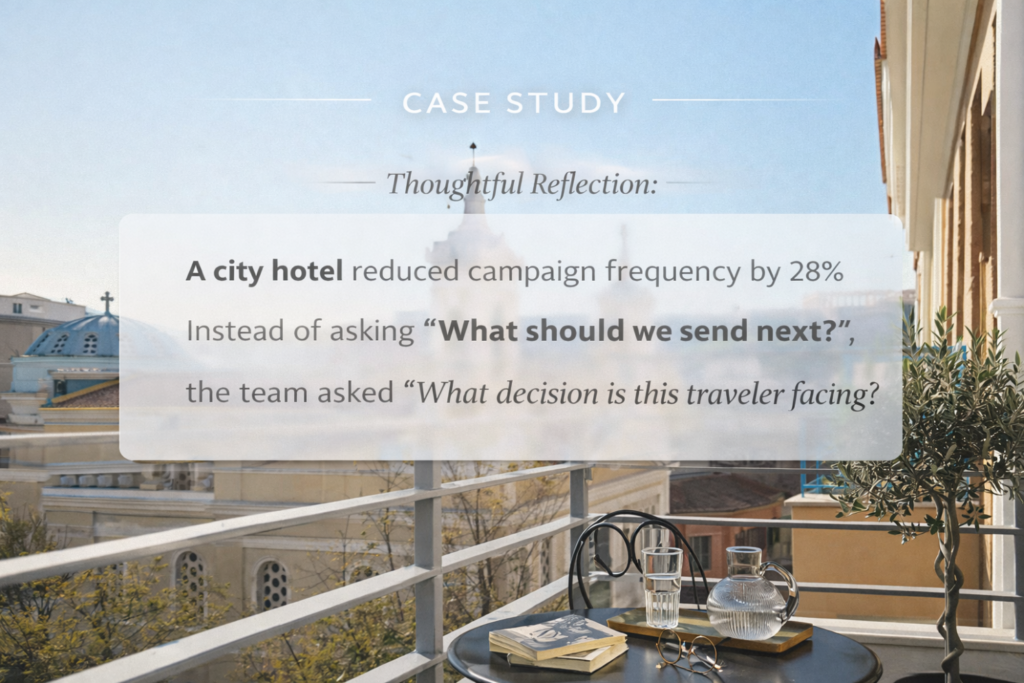
    A city hotel reduced campaign frequency by 28%. At the same time, it restructured communication based on traveler signals.

    Instead of asking “What should we send next?” the team asked “What decision is this traveler facing?”

    Results:
    • Higher engagement with fewer messages
    • Clearer attribution between content and bookings
    • Stronger conversion from high-intent travelers
    • Reduced fatigue and unsubscribes

    Less activity. More impact.

    Why Signal-Based Marketing Changes Everything

    When hotels operate on signals instead of assumptions:

    ✔ Marketing becomes adaptive

    ✔ Communication feels human

    ✔ Resources are used efficiently

    ✔ Direct bookings become predictable

    ✔ Trust grows naturally


    The goal is no longer to be seen. It’s to be useful at the right moment.

    Subscribe Today
    Hospitality leaders don’t guess — they analyze. Get weekly data-driven insights designed to increase direct revenue.
  • Why most hotel marketing fails before it even starts
    Why most hotel marketing fails before it even starts

    Why most hotel marketing fails before it even starts

    What Smart Hotels Do Differently

    In most hotels, marketing begins with the right intention: to increase bookings.

    But in reality, it begins with the wrong question.

    Which channels should we use?

    How much budget should we allocate?

    The real question is much simpler — and far more critical:

    Who are we trying to reach, and where are they in their decision journey?

    Without this clarity, every campaign becomes noise.

    Marketing doesn’t fail. Targeting does

    Travelers are not uninterested. They are overexposed.

    They’ve seen:

    • the same visuals
    • the same promises
    • the same “limited offers”

    And they’ve learned to ignore anything that isn’t immediately relevant.

    The problem is not demand. The problem is relevance.

    The dangerous illusion of the “broad audience”

    The larger the audience, the more generic the message becomes. And the more generic the message, the less it converts.

    A family resort, a boutique adults-only hotel, and a city hotel cannot speak to the same traveler — no matter how good the creative looks.

    Yet most campaigns still try.

    The mindset shift hospitality needs in 2026

    Modern hospitality marketing does not start with the hotel. It starts with traveler behavior.

    • Different messages for early planners
    • Different messages for last-minute bookers
    • Different messages for experience-driven travelers
    • Different messages for price-driven travelers

    When these differences are ignored, results become accidental.

    Why structured insight beats louder marketing

    When a traveler is no longer just “an email,” but a profile with:

    • intent
    • preferences
    • behavioral patterns
    • evolving interest over time

    communication stops feeling like advertising and starts feeling timely and useful.

    This month’s insight

    Hotels don’t need more campaigns. They need better decision architecture.

    Not more volume. More precision.

    Not more tools.

    More understanding of the traveler.

    Closing thought

    If your marketing speaks to everyone, it’s probably heard by no one.

    The competitive advantage isn’t who sends more. It’s who sends right.

    Subscribe Today
    Hospitality leaders don’t guess — they analyze. Get weekly data-driven insights designed to increase direct revenue.