Why Direct Control Is the New Luxury in Hospitality
For years, growth in hospitality was measured by visibility. More listings. More platforms. More intermediaries.
And for a long time, this felt like progress.
But today, hotels are realizing something fundamental: visibility without control is fragile.
In Destinova Insights | Issue #10, we explore why owning the guest relationship has become the most valuable asset a hotel can build — and why control is no longer a technical advantage, but a strategic luxury.
How Hotels Grow Direct Bookings Without Overcommunicating
As hotels grow their databases, campaigns often multiply. More segments. More messages. More pressure to “stay visible”.
And suddenly, communication becomes noisy.
Guests disengage. Open rates drop. Brands feel intrusive instead of relevant.
In Destinova Insights | Issue #9, we explore how hotels can scale direct bookings without overwhelming their audience — by shifting from volume-driven communication to intelligent orchestration.
The Scalability Trap
Growth often leads to overcommunication.
What starts as personalization slowly turns into:
too many emails
overlapping campaigns
repetitive messages
unclear priorities
The result isn’t higher engagement. It’s fatigue.
Hotels don’t lose guests because they stop communicating. They lose them because they communicate without coordination.
What Scaling Really Means in Hospitality
Scaling is not about sending more. It’s about aligning everything.
True scalability means:
each traveler receives fewer but more relevant messages
campaigns don’t compete with each other
communication feels intentional, not automated
every message has a clear purpose
This requires orchestration — not effort.
The Destinova Orchestration Model
At Destinova, scaling happens through controlled complexity.
1. Priority-based messaging – Not all messages are equal. High-intent travelers receive priority. Low-intent travelers receive inspiration — not pressure.
2. Frequency intelligence – Communication adapts to engagement levels. Active travelers hear from you more often. Passive ones less — without disappearing.
3. Journey-aware sequencing – Messages follow a logical journey: Inspiration → Consideration → Booking → Retention Not random campaigns competing for attention.
4. System-level visibility – Hotels see:
which messages overlap
where fatigue begins
how engagement evolves over time
Scaling becomes predictable — not chaotic.
Case Study: Growing the Database Without Losing Engagement
A resort group expanded its database by 48% in one year. Initially, engagement dropped.
After implementing Destinova’s orchestration model:
campaigns were re-prioritized
message frequency was aligned with traveler behavior
overlapping sends were eliminated
Growth didn’t come from speaking more. It came from speaking smarter.
Why Orchestration Is the Next Competitive Advantage
n a world of automation, silence is not the enemy. Noise is.
Hotels that master orchestration:
Scale without losing relevance
Protect brand perception
Increase lifetime value
Reduce churn and fatigue
Turn communication into a strategic asset
Growth doesn’t come from presence. It comes from precision at scale.
The most profitable booking is the one you don’t have to fight for again
A guest checks out. The room is cleaned. The season moves on.
And in most hotels, the relationship ends there.
But what if that moment — the one right after checkout — was actually the beginning of your next booking?
In Destinova Insights | Issue #8, we explore one of the most overlooked growth levers in hospitality: guest retention and lifetime value.
Because in an era of rising acquisition costs and increasing OTA dependency, growth doesn’t always come from finding new guests — it comes from not losing the ones you already earned.
The most profitable booking is the one you don’t have to fight for again.
Every season, many hotels face the same challenge: fill rooms again.
New campaigns. New budgets. New pressure.
This constant restart creates hidden costs:
Marketing spend keeps increasing
OTA dependence becomes structural
Guest relationships remain shallow
Brand memory fades after checkout
When retention is not part of the strategy, even a successful booking becomes a missed long-term opportunity.
Guest Lifetime Value Is Not a Loyalty Program
Guest Lifetime Value (GLV) is often misunderstood.
It’s not about points. It’s not about discounts. And it’s not about generic “We miss you” emails.
True GLV is about continuity.
A high-value returning guest:
Books with less hesitation
Chooses direct instead of OTAs
Responds to relevant communication
Spends more on repeat stays
Feels emotionally connected to the brand
This kind of loyalty isn’t accidental. It’s designed.
In vehicula ante vel ex commodo, quis blandit eros fermentum. Nam hendrerit purus sit amet condimentum gravida. Proin at est leo. Curabitur nec odio eros. Donec leo nisi, facilisis vel euismod ac, rutrum non ante. Suspendisse ut ligula ac mauris faucibus dignissim pharetra vitae nunc. Quisque pharetra mi sed nunc tincidunt, nec fermentum nisl viverra. Vivamus eget ipsum et leo pellentesque blandit vitae non sem.
The Moment Hotels Ignore — and Shouldn’t
The most powerful emotional moment in the guest journey is not the booking.
It’s the moment after the stay.
The experience is still fresh. The emotions are still vivid. The memory is still forming.
Yet most hotels go silent — sometimes for months — until the next promotion.
At Destinova, we treat post-stay communication as the bridge between today’s experience and tomorrow’s booking.
The Destinova Retention Framework
Retention works when communication feels intentional, not repetitive.
Our framework focuses on four principles:
1. Reflect the experience
Remind guests why they enjoyed their stay. Moments. Atmosphere. Feeling.
2. Extend the destination story
Seasonal highlights, local culture, reasons to return — not offers.
3. Personalize future intent
A family doesn’t return for the same reason as a couple or a luxury traveler. Retention starts with understanding why they came the first time.
4. Time the re-engagement
Not too soon. Not too late. Aligned with real booking behavior patterns.
Retention is not about frequency. It’s about relevance and timing.
Case Study: From One-Time Guest to Predictable Revenue
A boutique hotel in Crete had excellent guest reviews and high satisfaction scores, yet a low percentage of repeat bookings.
After implementing Destinova’s post-stay retention strategy:
guests were segmented based on experience type and travel intent
communication focused on memory recall and anticipation of a return visit
message timing was aligned with real booking behavior patterns
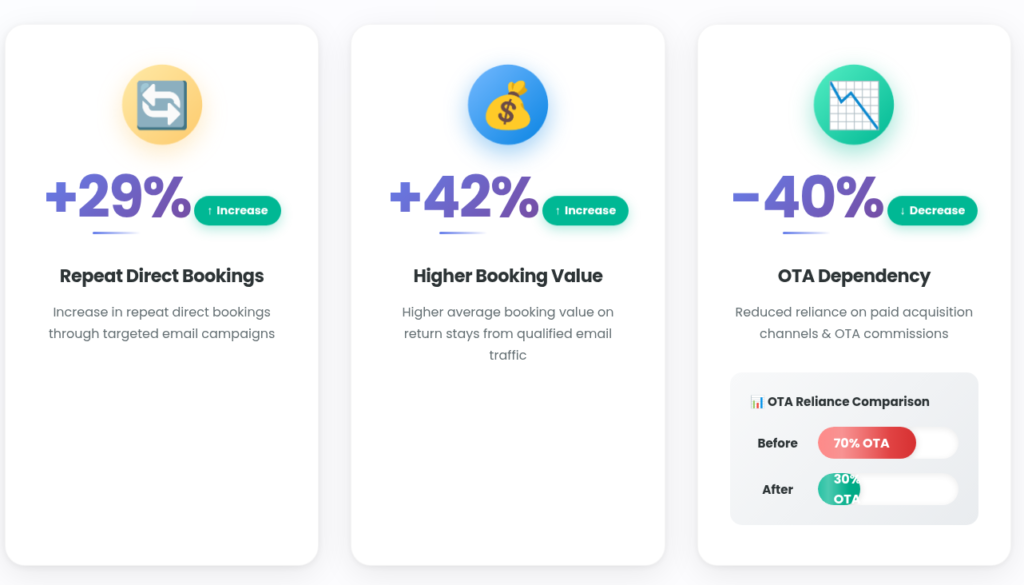
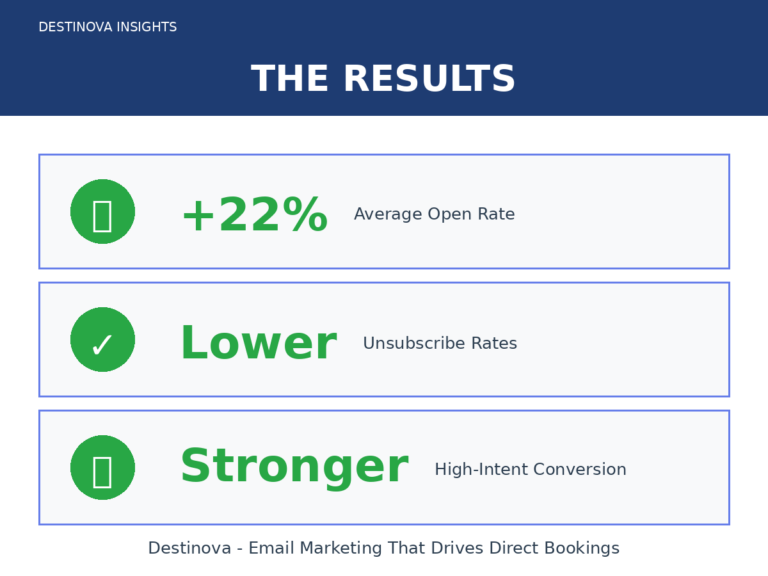
Results:
The hotel didn’t offer discounts. It reminded guests why Crete was the destination they wanted to experience again.
Many hotels still approach marketing as a series of disconnected actions. A campaign here. A promotion there. A seasonal push when occupancy drops.
But direct bookings don’t grow through isolated efforts. They grow when every element works together as a system.
In Destinova Insights | Issue #7, we explore how hotels move from short-term campaigns to a sustainable direct booking engine — one that operates continuously, intelligently, and profitably.
The Campaign Trap
Campaigns feel productive. They create activity, urgency, and short-term spikes.
But they also create problems:
No continuity in communication
No cumulative learning
No long-term traveler relationship
Constant dependency on discounts or urgency tactics
Hotels end up restarting the same effort again and again — without building momentum.
What a Direct Booking System Really Is
A direct booking engine is not a single campaign. It’s a connected ecosystem where:
Segmentation defines who you speak to
Personalization shapes how you speak
Timing intelligence determines when you speak
Content gives meaning to the message
Measurement reveals what works and what doesn’t
When these layers operate together, communication becomes consistent, relevant, and compounding.
Each email doesn’t start from zero. It builds on everything that came before.
How the Destinova System Works
At Destinova, we don’t run campaigns in isolation. We build direct booking systems designed to evolve with every interaction.
Each traveler interaction feeds the system:
Engagement updates segmentation
Segmentation informs personalization
Personalization improves timing accuracy
Timing increases conversion probability
Conversion data refines future content
This creates a self-optimizing loop — where performance improves over time without increasing pressure on budget.
Case Study: From Sporadic Campaigns to Predictable Revenue
A city hotel relied on last-minute campaigns to fill occupancy gaps. Results were inconsistent and heavily discount-driven.
After transitioning to a system-based approach:
Communication became continuous, not reactive
Content evolved based on traveler behavior
High-intent segments received priority focus
Discounts were replaced with experience-led messaging
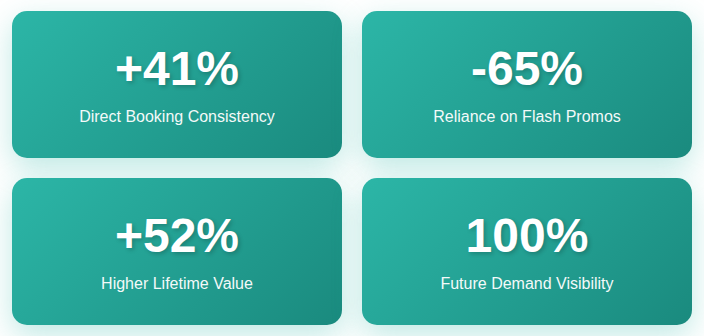
Results:
The hotel stopped chasing bookings — and started attracting them predictably.
Why Systems Outperform Campaigns
Campaigns end. Systems compound.
A system allows hotels to:
Build long-term traveler relationships
Learn from every interaction
Improve performance without increasing spend
Reduce OTA dependence sustainably
Turn marketing into infrastructure — not expense
This is how direct bookings become a business asset, not a seasonal goal
Measuring What Matters: The Metrics That Actually Drive Direct Bookings
In a world full of data, the real challenge is knowing which numbers shape decisions — and which simply decorate reports.
Every hotel generates data. Very few turn that data into profit.
Open rates, impressions, and clicks are easy to measure — but they rarely answer the questions that matter most to hoteliers:
Who is ready to book? Why did this campaign perform better? What truly influences direct revenue? How much money did we save from OTA commissions?
In Destinova Insights | Issue #6, we explore a simple truth: what you measure shapes what you achieve. And in hospitality, choosing the wrong metrics can cost thousands in missed revenue.
The Hidden Problem: Hotels Are Measuring the Wrong Things
Most hotel marketing reports highlight metrics that look good — but don’t help a hotel grow:
High impressions (but low intent)
Strong engagement (but no bookings)
Big audiences (but wrong travelers)
Clicks (but no conversion)
These are vanity metrics. They can create excitement — but not bookings.
Hotels don’t need more numbers. They need clarity, direction, and impact.
The Metrics That Actually Drive Commercial Results
At Destinova, we focus on performance indicators that reveal real booking potential — not just digital activity.
1. Intent Signals — The earliest predictors of revenue
These don’t just show interest. They show motivation:
Multiple opens over time
Engagement with destination content
Scroll depth in emails
Click distribution (which links reveal intent?)
Intent signals identify the travelers who are already imagining their stay.
2. High-Intent User Behavior — Where interest becomes consideration
These actions separate browsers from future guests:
Returning to see the same room type
Price-check behavior
Engagement with “where to stay” content
Engagement timing peaks
These moments uncover booking readiness.
3. The Revenue Metrics — Where strategy becomes measurable outcome
These are the metrics every hotelier should watch:
Direct booking conversion rate
Revenue per email / per traveler segment
Cost per direct booking vs OTA commission avoided
Attribution clarity per campaign
These numbers reveal the truth behind performance. They show where your revenue comes from — and where it is leaking.
In hospitality, attention is earned — and content is how you earn it.
A traveler doesn’t open an email to read an announcement. They open it to confirm a feeling: “Is this the place where I want to be next?”
This is why travel email marketing is unlike any other category. It is not transactional — it is experiential. It is not about selling — it is about guiding a traveler into a future moment they want to live.
In Destinova Insights | Issue #5, we break down how content becomes the engine that drives both engagement and direct commercial results.
The Psychology Behind High-Performing Travel Emails
Hotels often assume that better design produces better engagement. But the truth is simpler — and more powerful:
Content creates the feeling. Feeling creates the click. The click creates the booking.
In hospitality, the best-performing emails consistently follow three principles:
1. They Inspire (Emotion Before Information)
A view that sparks desire. A moment that feels personal. A narrative that reminds travelers why they long to escape.
This is the “dream-building” phase — the part that OTAs can never replicate.
2. They Guide (Value Before Promotion)
“What to do – What to visit – Where to stay.” Travelers respond strongly to emails that help them imagine the experience, not just the offer.
Hotels that provide micro-itineraries and local insights see significantly higher engagement.
3. They Convert (Clarity Before Complexity)
A direct CTA to the hotel website — clear, simple, frictionless. This is where content becomes revenue.
The Destinova Content Framework for High Engagement
At Destinova Greece, content is not decoration. It is a strategic structure designed to move a traveler from interest → intent → booking.
Timing Intelligence: When the Right Moment Becomes the Message
There’s a rhythm in every traveler’s decision-making. Some plan months ahead — comparing destinations, building wishlists, dreaming in advance. Others act on impulse — a sudden need for escape, a moment of inspiration, a last-minute window of freedom.
And between these two extremes lies the truth: Timing can turn interest into action. Or let it fade.
In Destinova Insights | Issue #4, we explore how timing intelligence shapes the success of every campaign — and why the when often matters as much as the what.
Why Timing Changes Everything
A perfectly crafted message delivered at the wrong moment is simply noise. But a relevant message delivered at the right moment becomes momentum.
With Destinova’s traveler intelligence, timing is no longer guesswork. It becomes part of the strategy:
Early Planners who book 3+ months out
Last-Minute Bookers who convert within days
Seasonal Behavior Patterns formed year over year
Engagement Signals that reveal readiness
Micro-moments when a traveler is most likely to take action
These signals change daily — and so does their likelihood to book.
When emails sync with behavioral timing, engagement lifts organically. Not because you push harder. But because you speak exactly when the traveler is listening.
Case Study: The Power of Perfect Timing
A coastal hotel in Crete wanted to increase shoulder-season bookings. Instead of sending one generic campaign, Destinova triggered sends based on timing behaviors:
Early planners received curated experiences 90 days before their typical booking window
Spontaneous travelers received last-minute offers at high-intent moments
Sunset lovers received inspirational content after engaging with summer photos
The results:
32% increase in off-season direct bookings
2.4× higher click-through rates
Reduced dependency on discounting
Same content. Different timing. Completely different outcomes.
Timing Is a Form of Hospitality
Travelers don’t want more emails. They want emails that arrive when they’re ready to dream — or ready to book.
Timing isn’t just a technical capability. It’s an emotional one.
A moment of relevance. A moment of connection. A moment when the traveler feels understood.
And that moment can be the beginning of a booking.
For hotels, sending the right message to the wrong traveler is like whispering in a crowded room — you’re talking, but no one’s really listening.
In a market filled with ads and competing offers, precision has become one of the most valuable assets in hospitality marketing. This is where segmentation transforms from a marketing term into a genuine revenue driver.
What Segmentation Really Means
At Destinova, segmentation isn’t about lists — it’s about understanding travelers as real people with real intentions. We go beyond demographics into behavior, interests, and booking patterns.
Each traveler carries a dynamic set of tags that define their profile:
Trip Type: Beach • City Break • Culture • Family • Adventure • Wellness
Booking Behavior: Early Planner • Last Minute Booker • Repeat Guest
These segments evolve based on real engagement, ensuring accuracy and relevance.
From Data to Experience
This multi-layer taxonomy allows hotels to communicate in context. Instead of generic campaigns, travelers receive content that feels tailored — aligned with what they actually want.
A family resort highlights its kids’ activities.
A boutique hotel showcases local cultural spots.
A luxury villa speaks to privacy, exclusivity, and premium experiences.
The result:
Higher engagement, stronger loyalty, and direct bookings with zero OTA reliance.
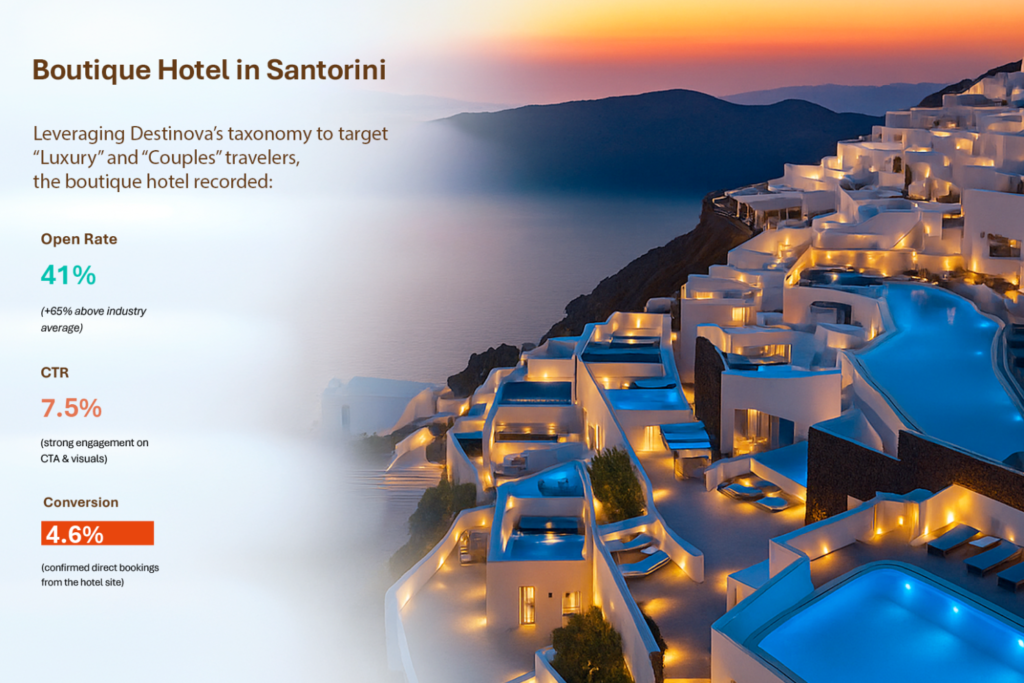
Case Study: Boutique Hotel in Santorini
By targeting the “Luxury” and “Couples” segments using Destinova’s taxonomy, a boutique hotel achieved:
41% open rate
High click-through engagement
3 out of 10 clicks converting into direct booking inquiries
Precision outperforms volume — every time.
Why It Matters
In digital marketing, reach is easy. Relevance is the real differentiator.
Segmentation is the bridge between data and emotion — where digital intelligence meets true hospitality.
In today’s hospitality landscape, hotels face rising OTA commissions, fragmented marketing channels, and decreasing control over their guest relationships. For every €100 booking, up to €25 goes to intermediaries — instead of staying with the hotel.
It’s time for a change. It’s time to turn every message into measurable revenue.
The New Model of Hospitality Marketing
At Destinova, we believe performance starts with precision. That’s why we built a data-driven email marketing platform connecting Greek hotels directly with verified travelers — no commissions, no middlemen.
15M+ verified travelers
Taxonomy segmentationbased on real interests
Direct CTAthat drives bookings straight to your site
Full transparency with open, click & booking data
Every campaign becomes a personalized experience that brings travelers closer to your destination — and your brand.
Maintain Battery Health
Suspendisse id blandit libero. Cras nec tincidunt ante, ac lacinia ipsum. Nullam luctus ac justo ac molestie. Etiam rhoncus eget est quis porttitor. Curabitur ullamcorper sollicitudin risus, non porttitor augue euismod efficitur. Morbi gravida in lorem eget suscipit. Cras non diam aliquet, eleifend lorem sed, fringilla felis. Sed in aliquet dolor. Nunc convallis aliquam massa, at efficitur orci accumsan eu. Sed et semper erat.
In vehicula ante vel ex commodo, quis blandit eros fermentum. Nam hendrerit purus sit amet condimentum gravida. Proin at est leo. Curabitur nec odio eros. Donec leo nisi, facilisis vel euismod ac, rutrum non ante. Suspendisse ut ligula ac mauris faucibus dignissim pharetra vitae nunc. Quisque pharetra mi sed nunc tincidunt, nec fermentum nisl viverra. Vivamus eget ipsum et leo pellentesque blandit vitae non sem.
Case Study: Family Resort in Rhodes
One resort joined Destinova to boost summer occupancy.
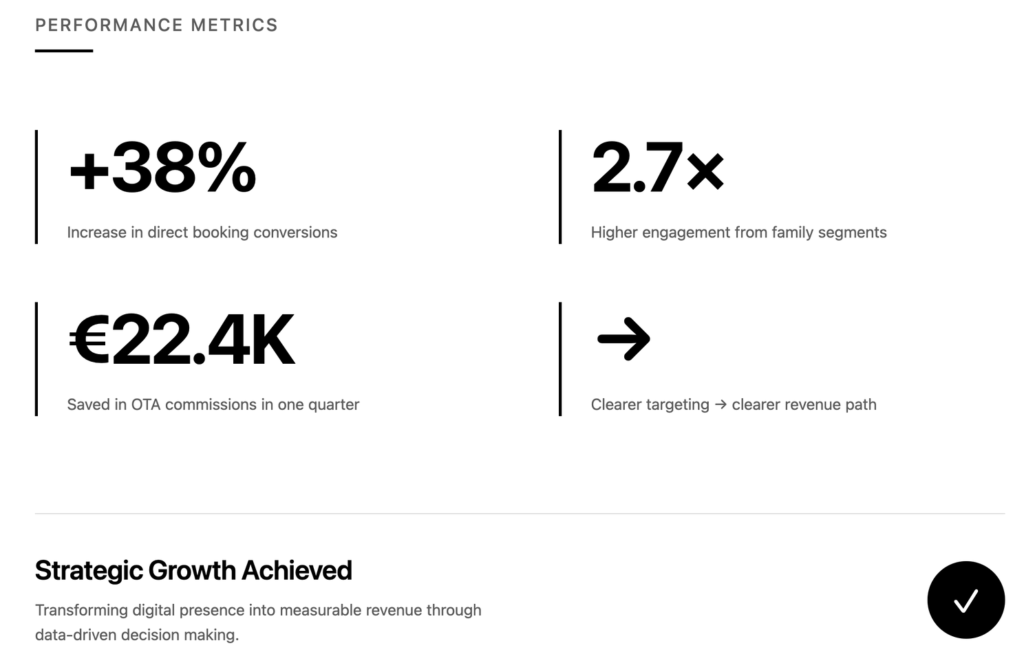
Within the first month:
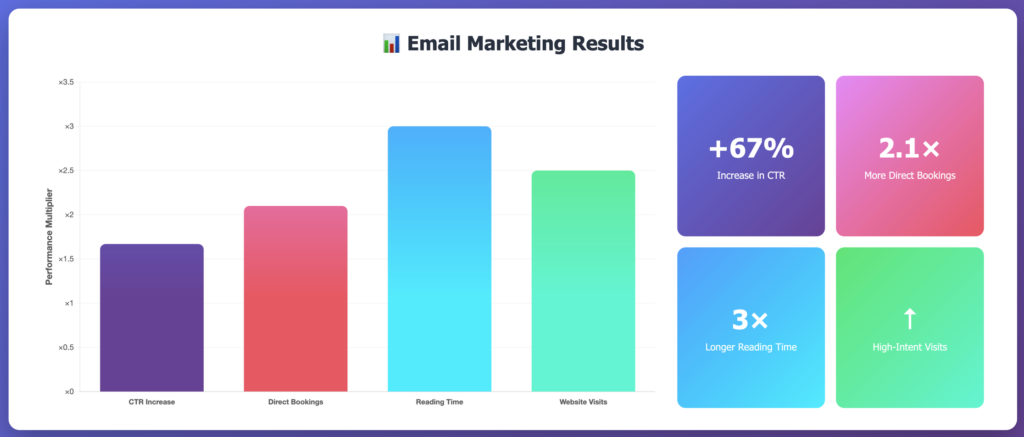
Results that redefine what an email can do.
Data Tip of the Month
Use interest-based taxonomy segmentation — tag your travelers as Beach, Culture, Family, or Luxury. Matching content to traveler intent can double engagement and significantly improve conversion to bookings.
Why It Matters
Hospitality isn’t about algorithms — it’s about people. But when data and authenticity meet, hotels reclaim control of their story. That’s the essence of Destinova.